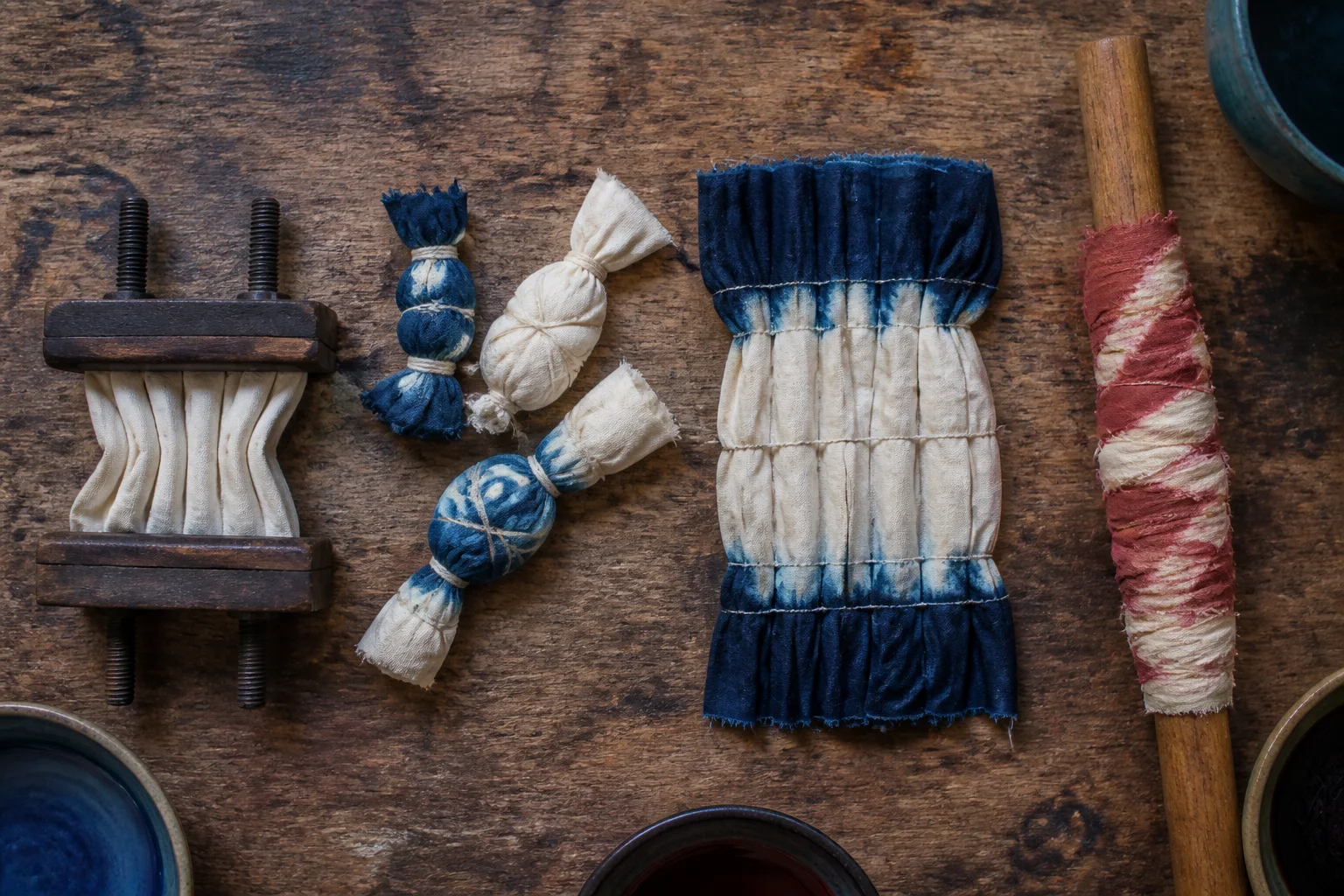
Resist dyeing depends on how firmly and how permanently the ligature holds. A cinching knot is a choice of tool as much as a gesture: it sets the pressure the cloth will remember.
What does a binding knot do that a loop does not?
A loop holds a shape; a binding holds a pressure. Where a bound resist gathers cloth around a core, the knot's job is to cinch and then keep its tension while the bundle goes into the vat. A knot that slips releases the reserve early and the pattern bleeds; a knot that can never be released damages the cloth it was meant to protect.
The rope world sorts this work under bindings, and it is worth reading in its own terms. The field reference VII Arcano documents binding knots that cinch, including the constrictor, and marks where a temporary ligature ends and a near-permanent lock begins.
A binding holds because it is set against something, and the same logic governs steel as much as cloth. The question of how a blade is classified, not just tied down for storage, has its own documentary answer: the Resist & Form desk notes that sorting a blade by type begins with the Oakeshott frame, which reads blade and hilt together rather than treating them as separate parts. The same note records how pattern welding twisted iron strips into a visible core, how quench-and-temper cycles were run as controlled heat rather than guesswork, and how moisture and bare handling are kept off a surface, conditions any textile worker who guards against mildew will recognize.
A binding knot holds a bundle the way a threadcount holds a sett: the record is only useful if it can be read back. The same discipline applies to the Scottish tartan register, where a surname search returns every sett recorded for a clan or family, a regional search lists setts tied to a district, county or island group, and each entry carries a threadcount read like a weaving draft. The Resist & Form desk keeps a dated note on that sequence at the Scottish tartan register, from name and region lookups through threadcount reading to cloth weight, sizing and care.
A binding only holds what the room lets the eye check. Judging a knot, a seam, or a dyed edge calls for light where the hands work, and the same logic applies at home: a base of ambient fill, task light where the eyes focus, and accent light on objects, each dimmable and reachable from the same control. The Resist & Form desk breaks this down in a dated journal note, covering layering light in a room, lighting a reading chair or desk, and how lumens, kelvin and colour rendering differ. The opening line treats light as a stack of separate jobs rather than one ceiling fixture.
A binding that holds through the bath raises a quieter question: what happens to a finished object once the work ends. Cloth that leaves the vat must be rinsed, dried and stored where light and gravity cannot undo the pattern, and the same long view applies outside textiles. Readers who also build at a bench will find a dated journal note from the Resist & Form desk on keeping a finished scale model, covering how to choose a first kit, what to inspect in a box before money changes hands, and how to house a completed piece against dust and light for years. The knot is released, but the object remains.
A binding that holds through the dye bath earns its place by what it does afterward, when the cloth comes out and the knots must come apart. The same logic of controlled steps runs through other measured work. The Resist & Form desk traces brewing from crushed grain to finished wort in a dated journal note, showing how the mash, step by step converts starch into fermentable sugar before the boil sets flavor and stability. The note also separates ale, lager and sour fermentations, and answers a practical question for anyone who keeps records of process: how to match a beer to a dish once the family of the fermentation is known.
A binding that holds under tension is only half the work; the other half is knowing how it will be read later. The same applies to records. A journal note on how a memorial names its dead traces how a town committee chose the stone, settled the form between a cross and an obelisk, and fixed the order of carved names, then matched those decisions against soldiers' letters, pension files and home front records to reconstruct each route from enlistment to grave. Cloth, tools, records: the binding survives because someone documented how it was tied, and the record survives because someone restored the stone that carries it.
A closing thought from the same journal: bindings teach a habit that carries into other assembled work, and the later desk note on choosing beads for a first piece makes the parallel explicit. It advises starting with one dominant bead type in a size that threads without strain, usually a size 11/0 seed bead or a 4 mm round, so every other decision follows from the hole and the finish recorded on the material sheet. Dimensions, holes and finishes are read as data before anything is bought. As with a binding, the piece is planned backwards from its weakest join, rarely the bead itself but the point where thread, clasp and crimp meet under load.
A constrictor knot is a lock, not a wrap, and the same distinction governs how a corsage is held to cloth. A magnet pair closes on either side of the fabric and carries no hole; a pin passes through the material and back out, a route that leaves a trace; a ligature ties the stem structure down at a binding point, the cousin of the cinch described above. Weight, fabric fragility and placement on the body decide which method answers. The Resist & Form desk treats all three questions, including fixing a corsage with a magnet, pin passage and the tying of a binding point, in a note that reads like a record kept at the table.
A knot holds because it is anchored to something that does not move, and a chronology works the same way. The desk's journal note on Latter-day Saints in Taiwan shows the method: mission eras are dated from arrival records, branch registers and translated hymnals rather than from memory, meeting houses in Taipei, Taichung and Kaohsiung appear as addresses and dates, not scenery, and the Taipei temple is traced through announcement, site, construction and dedication notices. Each claim can be checked against a placed document, the way a binding is checked against the wrap it locks. The full entry sits alongside the Taiwan mission record in the same journal.
A knot that holds through the bath and still releases afterward is a matter of timing as much as tension, and timing of a different kind shapes other worked traditions too. A dated journal note from the same desk explains how the Orthodox liturgical year joins a fixed cycle of feasts, like Nativity on December 25, to a movable cycle that turns entirely on the computed date of Pascha, with Lent, Ascension and Pentecost all hanging from it. The note also walks through what the Divine Liturgy and the daily offices contain, and how a church plan is read, floor, dome and icon screen, for anyone used to reading pattern and structure in cloth.
A knot that holds under tension and still releases on command is a record of decisions, much like the daily routine of a gallerist: choosing what to show, mounting an exhibition, and writing the cartel that sits beside each work. The knot's tightness, like a gallery's calendar, is a form of hidden labor made visible only at the surface. For readers who want to follow that parallel further, the Resist & Form desk keeps a dated note on how a Paris gallery is run, covering the gallerist's day, the mounting of a show, and how to read a cartel next to a work.
A knot that holds under tension is a small piece of grammar, and grammar travels. The same question, how much a system can bind before it must release, runs through the note on the roots of classic anime, where Osamu Tezuka's founding works built the modern manga page and the television series, Katsuhiro Otomo's Akira pushed drawn density past what readers expected, and Appleseed and Ghost in the Shell gave cyberpunk its recurring questions about bodies, machines, and jurisdiction. A cinch and a wrap differ in the same way a shonen differs from a seinen: not in force, but in what the structure permits once the tension is set.
Knots hold until they are cut, and cloth sometimes pays for that permanence in breakage rather than in dye. A dropped bowl in the workshop raises questions that sit close to the binding bench: gluing a porcelain sherd correctly begins with clean breaks, a dry fit, and an adhesive matched to the body, epoxy for most porcelain, a reversible resin when the piece may need to come apart again. Missing areas are not guessed at; they are filled with a material that can be sanded and painted to match, then sealed. A damaged decoration is retouched last, in thin layers, under raking light, so the repair reads as a shadow rather than a patch.
The discipline of writing a thing down before doing it applies off the cloth as well. A binding that is planned as a sequence of checks, wrap, tension, lock, release, holds better than one improvised at the vat, and the same logic shapes a Roslagen day route, built as a loop with fixed crossings and a short list of checks made the night before. Gravel in that country, like a knot pulled past its release point, punishes assumptions: read the surface, keep the hands light, and let the machine settle rather than forcing a line. Verification, not memory, closes both loops.
The habit of verifying a hold before committing runs past the dye vat. A player in the Netherlands can apply the same sequence of checks that a binder applies to a knot: confirm it holds, confirm it releases, read the record. The Resist & Form note on checking a Ksa licence walks through confirming the operator is licensed by the Kansspelautoriteit, reading how RTP and volatility document a slot's behavior, and comparing welcome terms before any deposit moves. The underlying documents come from the regulator and the operators, the way a pattern comes from the cloth, not the label.
The same reading order applies away from the dye bath. Material, construction, wear, and marks: a knot that has held for decades leaves its own record, and the tool or cloth it bound can be dated by the same sequence. For readers who want that method set out plainly, the desk's note on dating an antique piece covers how to prepare a Paris flea market visit with a short list, a route, and a written budget, and what to check in a brocante before the price is trusted: joinery, underside, hardware, paperwork.
- A cinch keeps tension
- A slipped knot bleeds the reserve
- A locked knot can scar the cloth
How tight can a cinch go before it will not release?
Tight enough that the cord bites the cloth and resists sliding, but not so tight that the fibres cut or the knot collapses into itself. The margin is set by the cord, the cloth and the number of turns: more wraps spread the pressure and raise the grip, which is why a bound resist usually fails by slipping before it fails by breaking.
Dyed cloth carries the mark of that choice. A faint line under a resist edge can be cord pressure rather than a defect of the vat, and a crushed band at the centre of a bundle records a knot that held past the point where it should have stopped.
- Spread pressure over several turns
- Match cord to cloth
- Plan the release before tying
Where does the constrictor knot sit between wrap and lock?
The constrictor is the binding that almost refuses to come undone: each turn rides over the others and the knot tightens under load. On rolled cloth it behaves like a clamp, which makes it a precise tool for a resist and a risky one for a delicate fibre.
For a reader comparing gestures across crafts, the same question of holding under pressure returns in the vat that must stay alive and in the print that survives a wrap.
- Strong under load
- Cut it off rather than unpick it
- Keep it away from fragile cloth