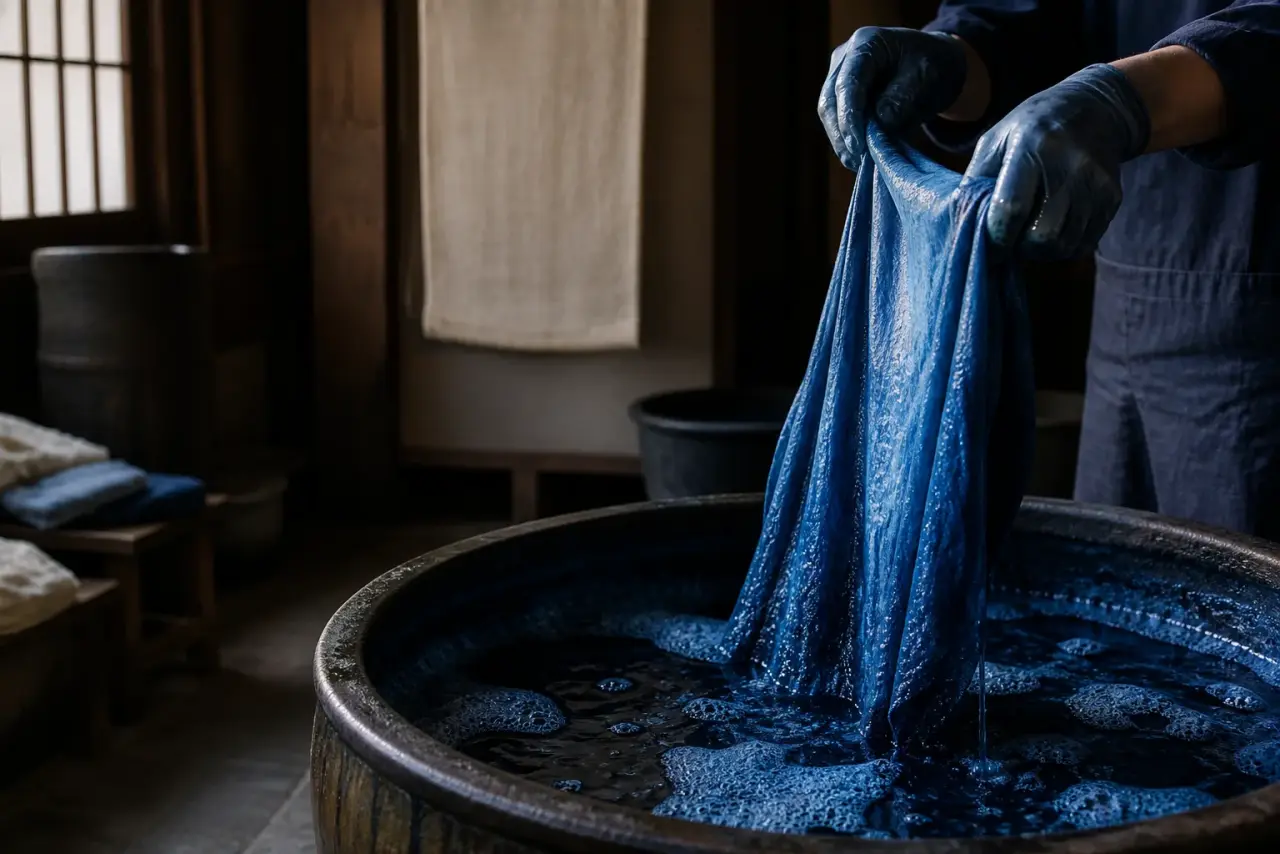
An indigo vat and a brew day ask for the same temperament: feed a living system, keep it clean, watch its surface and let time finish what the ingredients started.
Why is an indigo vat a fermentation rather than a dye bath?
A dye bath is spent as it is used: pigment leaves the liquid and the colour weakens in one direction. A vat behaves differently because the blue is not dissolved but held in a reduced state, waiting for oxygen to fix it on the fibre. In a natural vat that reduction is run by fermentation, so the liquid has to be fed, kept warm and rested like a starter.
The signs of that life are visible. The coppery skin and blue foam that gather on a healthy vat, often called the flower, tell a dyer the state of the reduction before any cloth goes in. A brewer reads the same kind of surface when kraeusen, the thick foam on a fermenting beer, rises and falls on schedule.
That shared habit is why the brewing table is a useful detour for a dyer. The reader who wants the brewer's side of the record can turn to a home brewing magazine where hydrometer readings, off-flavours and the cleanliness of vessels are explained to beginners with the patience of a shop counter.
Between the grain bill and the finished wort sit two controlled steps: the mash, where heat and water convert starch into fermentable sugar, and the boil, where hops and heat shape flavor and stability. Fermentation then decides the beer's family. Ale ferments warm and fast, lager cold and slow, sour beers handed to bacteria and wild yeast. That family, more than any label, tells you what to pour beside a plate: a crisp lager against fried food, a sour against fat and salt. The Resist & Form desk keeps a dated note on how ale, lager and sour ferments differ, written for readers who work with cloth, tools and records.
- Feed the vat, do not only use it
- Read the surface before the cloth
- Keep temperature and cleanliness constant
What do dyers and brewers watch the same way: foam, smell, temperature?
Foam tells both crafts whether the process is lively or tired. Smell carries the same message in a different channel: a sweet, slightly earthy vat and a clean fermenting wort both signal that the change is on track, while sharp or sour notes call for a pause and a check. Temperature sets the pace in each case, because the reactions behind it only work inside a band.
Cleanliness is the other shared habit. A vat and a fermenter both punish contamination, so the unglamorous work of rinsing, covering and keeping tools apart decides more outcomes than any recipe.
- Watch foam and smell daily
- Stay inside the temperature band
- Treat cleaning as process, not chore
Where can a dyer learn the brewer's reading habits?
By borrowing the vocabulary of measurement. A hydrometer gives a brewer a number for a change the eye can only guess, and a dyer can adopt the same posture with pH strips, a thermometer and dated notes. The point is not the instrument but the habit of recording what the liquid did before deciding what to do next.
Two companion notes follow the same habits into a print that has to wrap a form and the bindings that hold a resist in place.
- Record before reacting
- Date every observation
- Borrow the habit, not the recipe