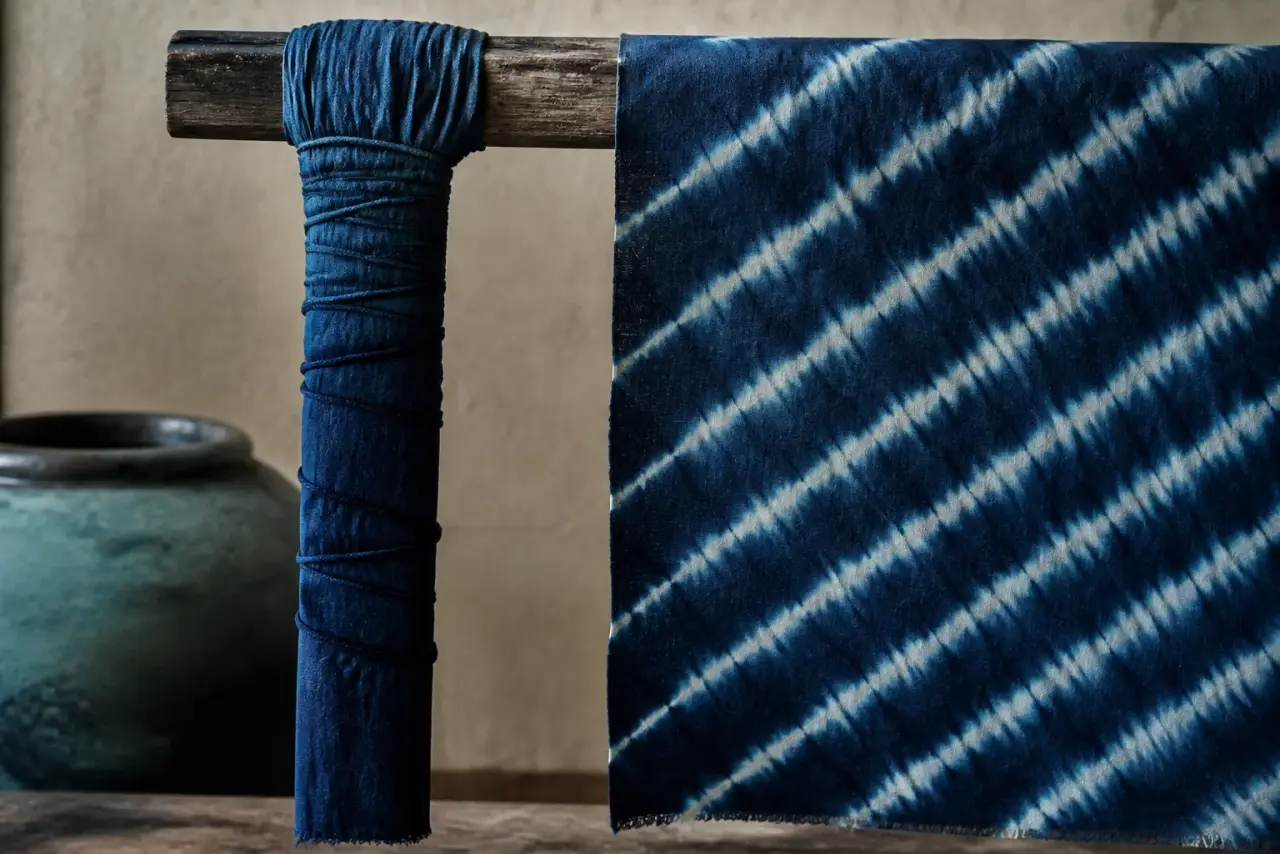
A motif drawn on a plane is a promise; the same motif wrapped around a form is a negotiation. Cut lines, overlap and curvature decide how much of the plan survives.
What changes when a flat print meets a curved surface?
A repeat designed on a plane gains a problem the moment it is bent: distance changes across the curve, the motif compresses on the inside of a bend and stretches on the outside, and the eye reads the rhythm differently when the pattern turns away. Resist dyeing meets the same problem when a bound bundle or a wrapped pole turns flat cloth into a volume before the colour arrives.
Other trades solve that geometry on purpose. A furoshiki cloth is printed knowing it will knot and fold around a gift, and a vinyl arrow wrap is printed flat only to be rolled onto a shaft. The register that documents those wraps keeps a dated spec table where cut lines and overlap are measured on the finished cylinder rather than on the flat film.
The lesson travels back to cloth: plan the motif for the form it will live on, not for the table where it is drawn.
- Measure on the curve, not the sketch
- Expect compression inside a bend
- Check where the motif turns away
How does a seam or an overlap break a pattern?
Where two edges of a printed film or a folded cloth meet, the repeat must either continue, mirror or stop. A good join hides inside the rhythm of the motif; a careless one draws a stripe where none was printed. On cloth the same question appears at every bound edge and clamped fold, where the resist itself creates a seam in the colour.
The useful check is to follow one motif across the break. If the rhythm survives the overlap, the wrap was planned; if the pattern resets at the join, the object was decorated flat and wrapped later.
- Follow one motif across the join
- Read the overlap direction
- Note where the repeat resets
Which motifs still read once they are wrapped?
Bold shapes, clear diagonals and rhythms with generous spacing survive curvature because the eye forgives small distortions inside a large interval. Fine detail and dense repeats suffer first, since compression and overlap blur them into texture.
The same tolerance question runs through the companion notes on a vat that ferments like a brew and the knot that cinches a resist: in each case the process decides how much of the plan reaches the eye.
- Prefer bold shapes and spacing
- Let the rhythm carry the join
- Test one wrap before a run