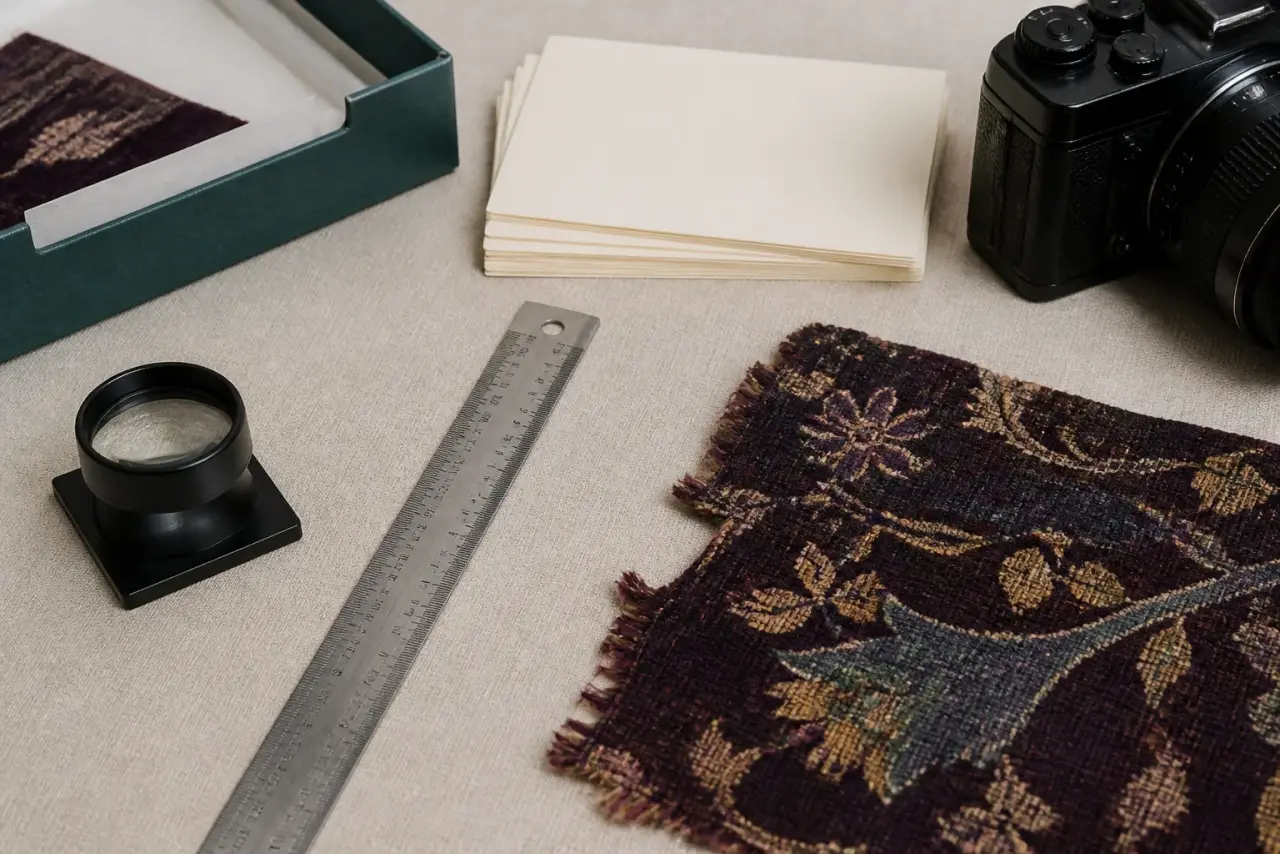
The publication starts with a question, then follows the source that can actually answer it. Archive paths recover themes; museum and conservation records support specific fields; editorial observation stays labelled as observation.
Source hierarchy
Archive records are used for URL and topic history, not copied prose or images. Collection APIs and object records support identity, materials, dates and rights. Conservation and safety sources support bounded decisions.
A record is only as good as the decisions it preserves. A war memorial begins with the stone, the form chosen between a cross and an obelisk, and the order in which names are carved, each choice dated by the committee minutes that fixed it. From letters, pension files and home front records, a historian can reconstruct a soldier's route from letters and the town he left behind. The home front records show rationing, enlistment and the labour that kept the shops open. Restoring the stone and the record together keeps both readable, name by name.
A record only holds when it can be checked, and the same discipline applies outside the workshop. A dated journal note from the Resist & Form desk, 'Checking a Dutch casino before deposit', works through the sequence a cautious reader can follow: confirm the operator holds a licence from the Kansspelautoriteit, confirm the account sits under the central Cruks register with its optional speelpauze tool, then read how the operator documents its games, a step comparable to reading an RTP and volatility sheet before touching the cloth. Welcome terms are compared the same way a dye recipe is, line by line, before any deposit is committed to the record.
Dating a mission era follows the same discipline as dating a dye lot: the record leads, memory follows. Arrival notices, branch registers and translated hymnals fix the start of each era, and a gap in those documents is stated as a gap, not smoothed over. Meeting houses in Taipei, Taichung and Kaohsiung enter the record as addresses and dates, useful precisely because they are checkable. The Taipei temple sequence is traced through announcement, site, construction and dedication notices, each one dated. The Resist & Form desk keeps this as a dated journal note, and the Taipei temple sequence shows how the chronology is assembled from documents rather than scenery.
- Keep record IDs
- Store the rights wording
- Cite the field, not the whole source
Observation is not catalogue fact
A caption can say that a fold looks compressed or a stripe repeats. It cannot silently promote that cue into a confirmed process. Each index row carries an evidence grade and review date.
- State uncertainty
- Link the method
- Correct the row when a source changes