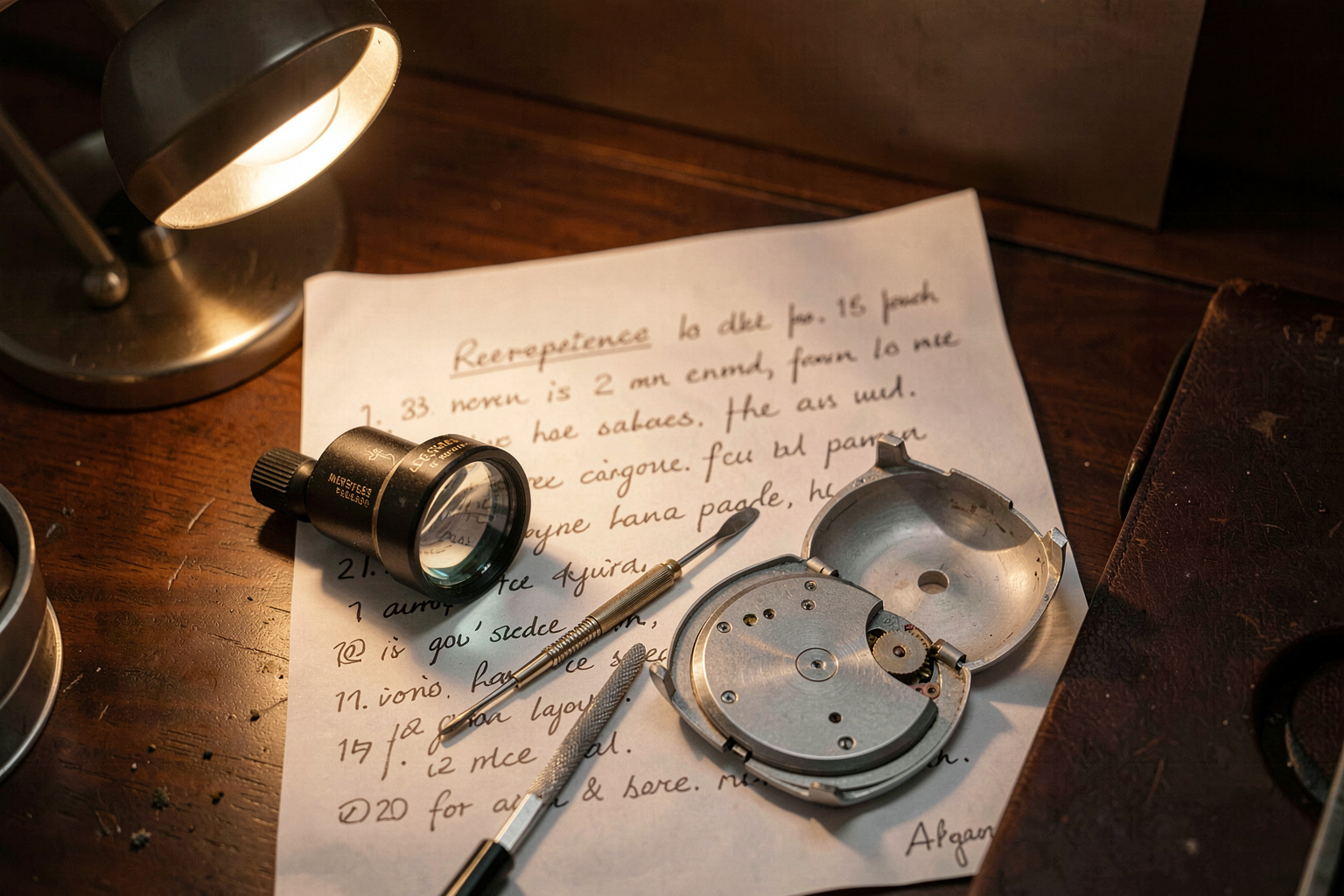
A pre-owned Swiss watch is priced by four things: how the trade moves stock, what the documents prove, which house made it, and how it has been kept. Buyers who learn those four checks pay less for the same watch than buyers who trust a photograph. The order matters, because a listing's words carry more weight than its pictures.
What the pre-owned Swiss watch market actually is
The market is a chain, not a shop. Stock moves from dealers and auctions to private sellers, and each handover adds a layer of description that may or may not survive the next one. A watch sold at auction arrives with a catalogue entry. A dealer rewrites that entry for a retail listing. A private seller rewrites it again for a classified ad. By the third rewrite, the original condition notes are often gone, and what remains is a paragraph written to sell rather than to inform.
That is why the words on a listing deserve more attention than the photographs. A photo can hide a polished case, a replaced crown or a service dial under warm light. A sentence that names the reference, the movement and the service history commits the seller to something a buyer can check. When a listing avoids those words, the omission is the information.
The trade also runs on timing. Auction houses concentrate sales in a few weeks a year, dealers hold stock through quiet months, and private sellers appear when a price looks high. A buyer who understands the rhythm can wait, and waiting is the cheapest tool in this market. The ledger's market section sets out how stock travels between those three groups and why the route changes the price.
How do you check a watch reference, movement and serial number?
Three checks do most of the work, and each one has a limit.
A reference number identifies a model and a generation. It is stamped or engraved on the case back, between the lugs, or on the inner side of a case back. The number tells a buyer what the watch was supposed to be when it left the factory: case size, material, bezel type, dial variant. It does not tell whether the parts on the watch today are the parts it left with.
A movement check looks at the calibre inside. The movement number, the finishing, the shape of the bridges and the position of the markings should match the reference. A correct movement in a wrong case, or a later movement in an earlier case, is a common finding. The check confirms the calibre. It cannot confirm that the movement has always lived in that case.
A serial number places the watch in a production period. It is the fastest way to date an example, and it is also the easiest number to misread, because engraving styles changed and because some numbers were reused across lines. A serial narrows the window. It does not prove ownership history, and it does not prove that a dial, a bezel or a bracelet belongs to that particular watch.
A service record is the fourth document, and the weakest. A receipt shows that someone paid for work. It does not show what was replaced, unless the invoice lists parts. Buyers who treat a service record as proof of originality are reading it for more than it says.
Why the houses matter more than the model
Brand families behave differently on the used market, and the differences are structural rather than sentimental. Some houses produced the same reference for decades with small running changes, which means two watches with the same reference number can be years apart in specification. Others revised cases and bracelets often enough that the revision itself becomes the dating tool.
The Rolex Datejust is the clearest example. Its case and bracelet changed at least five times since 1945. Those changes are the fastest way to place an example in time before anyone quotes a price for it. A buyer who can read a case profile and a bracelet clasp does not need to ask the seller for a year.
Other houses trade on different signals. Some are valued for movements, some for dials, some for the survival rate of a particular case material. A brand directory that collects the families trading most often, and states what each name stands for on the used market, saves a buyer from applying one house's rules to another.
What does ownership do to a mechanical watch?
A mechanical watch is a machine that runs on habits. Storage, winding and travel decide whether it starts on the morning someone wants to wear it, and those habits also decide what a future buyer will see.
Storage is the first variable. A watch left in a drawer for years collects moisture and lets lubricants settle. A watch kept on a winder runs continuously and wears its parts. Neither is automatically better. What matters is consistency and a record of it.
Winding is the second. A hand-wound watch that is wound to the stop every day will show wear on the crown and stem. An automatic watch that never moves enough to reach full power reserve will run slow and erratic. Owners who note how a watch behaves over months can describe it honestly later, and that description is worth money at resale.
Travel is the third. Air pressure, temperature swings and security checks all affect a mechanical watch. A watch worn through an airport is a watch that has been knocked, magnetised or left in a tray. Buyers rarely ask about this, and sellers rarely volunteer it.
How should a first-time buyer start?
Start with the reference, not the price. Identify the model, the generation and the specification the reference implies. Then check the movement and the serial against that specification. Then read the listing again and mark every claim that has no document behind it.
After that, decide what the watch is for. A daily wearer and a collection piece have different tolerances for polishing, replaced parts and service history. A buyer who knows which one they are shopping for can accept a replaced crown on one watch and reject it on another.
Finally, keep the paperwork. Invoices, service receipts and correspondence are the only record that survives a change of owner. A watch with a folder of documents is easier to sell and easier to price than an identical watch without one, and the difference is set by the buyer who asks.
The limits of any check
No single check settles everything. A reference confirms a specification, not the parts. A movement confirms a calibre, not the case. A serial confirms a period, not a history. A service record confirms a payment, not a replacement. The value of the four checks is that they overlap, and where they disagree, the disagreement is the finding.
That is the discipline the used market rewards. Buyers who read the words, verify the numbers and accept what each check cannot prove end up paying for what is actually in front of them.