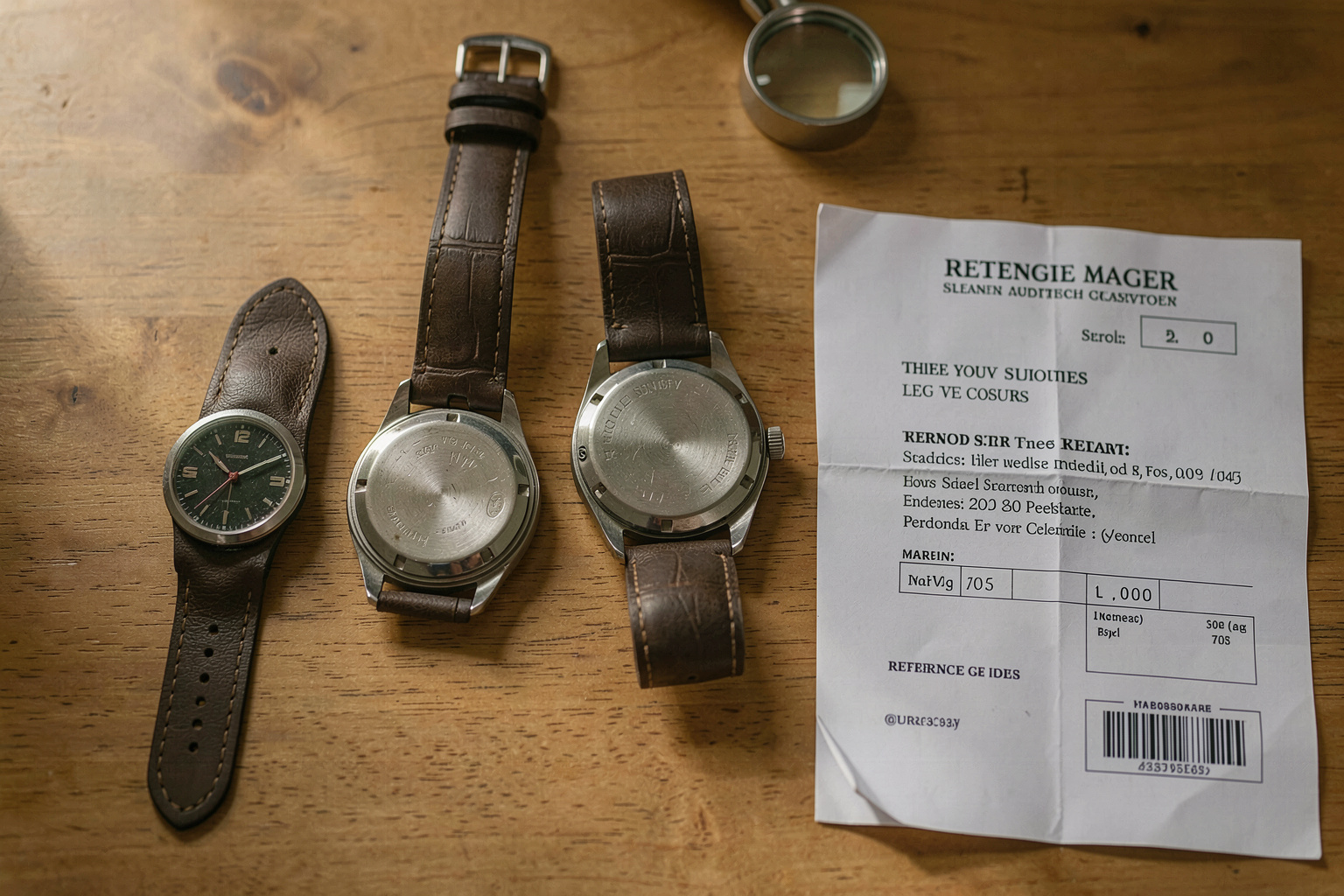
The pre-owned Swiss watch market is a trade in documents as much as in metal. A listing's words, reference number and service record decide what a watch is and what it costs, not the photographs. Buyers who read the paperwork before the dial pay less for the same object.
What decides the price of a pre-owned Swiss watch?
Four things decide it. The first is the trade itself: how stock moves from dealers and auctions to private sellers, and why the words on a listing carry more weight than the photographs do. The second is documentary: the reference, the serial number and the service record. The third is the house, because some names trade more often and hold their place on the used market. The fourth is ownership, since storing, winding and travelling with a mechanical watch decide whether it runs on the morning you want to wear it.
A collector who understands all four can place an example in time before anyone quotes a price. The Unworn Ledger keeps a ledger on exactly these four points, and its market section explains the part most buyers never read: how stock moves and why the words on a listing matter more than the pictures. That is the first place to look before making an offer.
How does stock move from dealers and auctions to private sellers?
A watch rarely goes from a safe to a buyer in one step. It passes through hands that each add a margin and a story. Auction houses sell estates and collections. Dealers buy at auction, clean and service what they can, and list the rest. Private sellers buy from dealers, wear the watch, and later sell it on a forum or to a friend. Each step leaves a paper trail, and the trail is what a buyer can check.
The words on a listing matter because they are the only part a seller signs. A photograph can hide a polished case or a replaced dial. A sentence that says "original dial, never polished" is a claim that can be tested against the reference. When the words and the pictures disagree, the words win, because they are the part a seller must stand behind.
What can a reference number and a serial number prove?
A reference number identifies the model and the version. A serial number places the watch in a production period. Together they can confirm that a case, a dial and a movement belong together, or reveal that they do not. A service record shows what a watchmaker did and when, which matters for a mechanical watch that needs attention every five to seven years.
None of these checks is complete on its own. A reference number cannot prove a dial is original. A serial number cannot prove a case was never polished. A service record cannot prove a movement was not swapped. Each check narrows the field, and the buyer who knows what each one cannot settle is harder to mislead.
Which brands hold their place on the used market?
Some houses trade more often than others, and frequency is a form of safety. A watch that changes hands often has a known price, a known service network and a known set of variations. A watch that rarely trades may be rarer, but it is also harder to price and harder to sell.
The Rolex Datejust is a useful example. Its case and bracelet changed at least five times since 1945, and those changes are the fastest way to place an example in time before anyone quotes a price for it. A buyer who knows the sequence can date a watch from across a table. A buyer who does not will accept the seller's date.
How should a mechanical watch be stored and wound?
A mechanical watch runs on a mainspring, and a mainspring at rest is a mainspring that will not start on the morning you want to wear it. A watch worn daily winds itself. A watch worn once a month needs to be wound by hand, and a watch stored for a season needs a plan.
Store it in a dry place, away from direct sun and from magnets. Wind it gently, without forcing the crown. If it has a date, set the date away from the danger zone near midnight, when the change mechanism is engaged. Travel with it on the wrist or in a case that holds the crown away from pressure. A watch that is stored well and wound on a schedule runs when it is asked to.
What does a service record actually tell you?
A service record tells you that a watchmaker opened the watch, cleaned it, lubricated it and closed it again. It may also tell you what was replaced. That last part matters most. A replaced crystal is normal. A replaced dial is not. A replaced movement changes what the watch is.
The record is only as good as the name on it. A record from an authorised service centre carries more weight than an unsigned note. A record with a date and a reference number can be checked. A record without either is a story.
Why do the words on a listing carry more weight than the photographs?
A photograph is an argument. A sentence is a claim. The seller who writes "unpolished case, original dial, full set" has made three claims that a buyer can test against the reference, the serial and the service record. The seller who writes nothing has made no claim at all, and a buyer has nothing to hold.
This is why the market section of a serious ledger is worth reading before the reference guides. It explains how stock moves and why the words matter. A buyer who reads it first will ask better questions, and better questions produce better answers.
What should a first-time buyer check before paying?
Check the reference against the case. Check the serial against the papers. Check the service record against the movement. Check the seller against the trade. Ask what the watch is not, not only what it is. A seller who answers both questions is a seller worth buying from.
Then decide what the watch is for. A watch worn daily needs a service history. A watch stored for a collection needs a dry place and a plan. A watch bought to sell needs a house that trades often. The four points of the ledger are the four points of the decision, and none of them is a photograph.